APartSML(2)——语法,类型与评估
1.Expressions
在 ML 语言中,程序执行的过程通常可以分为三步:语法解析、类型检查和评估。在语法解析阶段,ML 编译器会检查代码是否符合语言的语法规则,ML 是一种静态类型语言,这意味着所有变量和表达式的类型在编译时就必须确定。在类型检查阶段,编译器会根据语法树推断出每个表达式的类型,并检查类型是否符合预期。通过语法解析和类型检查后,ML 开始执行代码。这一阶段会对表达式进行实际求值,生成结果。
每类表示式的运行有三步:
(1)syntax:语法是什么
(2)type-checking:检查变量类型是否合法
(3)evaluation:获取变量值,抛出异常或进入循环
举例说明addition表达式
- syntax:e1+e2,e1和e2要求都是某个表达式
- type-checking:如果e1和e2是int类型,那么e1+e2也是int类型
- evaluation:如果e1评估值为v1,e2评估值为v2,那么e1+e2的值评估为v1和v2的和
2.Pairs and Tuples
ML中的pairs构建方式
syntax:(e1, e2)
type-checking:如果e1类型是ta,e2类型是tb,那么(e1, e2)类型是ta * tb
evaluation:如果e1评估值为v1,e2评估值为v2,那么(e1, e2)值评估为(v1, v2)
ML中的pairs读取方式
syntax:#1 e,#2 e
type-checking:如果类型是ta * tb,那么#1 e类型是ta,#2 e类型是tb
evaluation:e的值是一对,返回第一个值或第二个值
1
2
3
4
5
6
7
8
9
10
11
12
13
14
15
fun swap(pr : int * bool) =
    (#2 pr, #1 pr);

(* (int * int) * (int * int) -> int *)
fun sum_two_pairs(pr1 : int * int, pr2 : int * int)=
    (#1 pr1) + (#2 pr1) + (#1 pr2) + (#2 pr2);

(* int * int -> int * int *)
fun div_mod(x : int, y : int) =
    (x div y, x mod y);

fun sort_pair(pr : int * int) =
    if (#1 pr) < (#2 pr)
    then pr
    else (#2 pr, #1 pr);
1
2
3
4
5
6
7
8
9
10
11
- use "tuple.sml";
[opening tuple.sml]
val swap = fn : int * bool -> bool * int
val sum_two_pairs = fn : (int * int) * (int * int) -> int
val div_mod = fn : int * int -> int * int
val sort_pair = fn : int * int -> int * int
val it = () : unit
- swap(7, true);
val it = (true,7) : bool * int
- sort_pair(4,3);
val it = (3,4) : int * int
tuple可以有多个部分, tuple和pair可以嵌套,比如((7, true),9)
3.Lists
ML中的list可以有任何数量的元素,但是所有的元素类型都要相同
ML中的list构建方式
空列表是一个值:[]
列表形式:[v1, v2, …, vn]
如果e1值为v,e2值为[v1,…, vn],那么e1::e2值为[v, v1,…, vn]
ML中的list读取方式
null e:如果e为[],那么null e值为true
hd e:如果e值为[v1,…, vn],那么hd e为v1
t1 e:如果e值为[v1,…, vn],那么tl e为[v1,…, vn]
ML中的list type-checking
t list:表示这个list的所有元素类型都是t,比如int list,(int * int) list
[]:类型为’a list,表示可以为任何类型
1
2
3
4
5
6
7
8
9
10
11
12
13
14
15
16
17
18
19
20
21
22
23
24
25
26
27
28
29
30
31
32
fun sum_list(xs : int list) =
    if null xs
    then 0
    else hd xs + sum_list(tl xs);

fun countdown (x : int) =
    if x=0
    then []
    else x::countdown(x-1);

fun append(xs : int list, ys : int list) =
    if null xs
    then ys
    else (hd xs) :: append((tl xs), ys);

fun sum_pair_list(xs :(int * int) list) =
    if null xs
    then 0
    else #1 (hd xs) + #2 (hd xs) + sum_pair_list(tl xs);

fun firsts(xs : (int * int) list) =
    if null xs
    then []
    else (#1 (hd xs)) :: firsts(tl xs);

fun seconds(xs : (int * int) list) =
    if null xs
    then []
    else (#2 (hd xs)) :: seconds(tl xs);

fun sum_pair_lists(xs : (int * int) list) =
    sum_list (firsts xs) + sum_list (seconds xs);
用递归的方式实现list的常见方法
4.Let Expression
ML中Let构建方式
syntax:let b1 b2… bn in e and
type-checking:整个let-expression类型是e
evaluation:整个let-expression值是e
可以在let expression中使用nested function,即嵌套函数
1
2
3
4
5
6
7
8
9
10
11
12
13
14
15
16
17
18
19
20
21
22
23
24
25
26
27
28
29
30
31
32
33
34
fun silly1 (z : int)=
    let val x = if z > 0 then z else 34
    val y = x + z + 9
    in
    if x > y then x * 2 else y * y
    end;

fun silly2() =
    let
    val x = 1
    in
    (let val x = 2 in x+1 end) + (let val y=x+2 in y+1 end)
    end;

fun countup_from(x : int) =
    let
    fun count (from : int) =
        if from = x
        then x::[]
        else from::count(from+1);
    in
    count(1)
    end;

- use "let.sml";
[opening let.sml]
val silly1 = fn : int -> int
val silly2 = fn : unit -> int
val countup_from = fn : int -> int list
val it = () : unit
- silly2();
val it = 7 : int
- countup_from(7);
val it = [1,2,3,4,5,6,7] : int list
5.Let Efficiency
举一个求列表最大值的例子说明,用let expression来解决回溯重复操作问题
1
2
3
4
5
6
7
8
9
10
fun countup(from : int, to : int) =
    if from=to
    then to::[]
    else from::countup(from+1,to);


fun countdown(from : int, to : int) =
    if from=to
    then to::[]
    else from::countdown(from-1,to);
一个不好的实现代码:bad_max(tl xs)会重复执行,如果遇到的列表是正序,那么重复的次数会更多,因此在bad_max(countup(1,40))就会发现需要一点时间才能计算出来
1
2
3
4
5
6
7
8
9
10
11
12
13
14
15
16
fun bad_max(xs : int list) =
    if null xs
    then 0
    else if null (tl xs)
    then hd xs
    else if hd xs > bad_max(tl xs)
    then hd xs
    else bad_max(tl xs);

- bad_max(countup(1,20));
val it = 20 : int
- bad_max(countup(1,40));
  C-c C-c
Interrupt
- bad_max(countdown(30,1));
val it = 30 : int
为了避免重复操作,使用let expression提前存储bad_max(tl xs)的值,速度快很多
1
2
3
4
5
6
7
8
9
10
11
12
13
14
15
16
17
18
19
fun good_max(xs : int list) =
    if null xs
    then 0
    else if null (tl xs)
    then hd xs
    else
    let val tl_ans = good_max(tl xs)
    in
        if hd xs > tl_ans
        then hd xs
        else tl_ans
    end;

- bad_max(countdown(30,1));
val it = 30 : int
- good_max(countup(1, 400));
val it = 400 : int
- good_max(countdown(400,1));
val it = 400 : int
关键:不要重复某些操作,提前存储保留某些值进行局部绑定,能有效减少耗时
6.Option
在5.Let Efficiency中,对于空列表返回的是0,这可以运行但是显然不合理,我们希望函数可以返回多种类型,可以代表空,也可以是int,ML提供了Options
NONE:代表’a option,比如[]的类型是’a list
SOME e:如果e类型为t,那么SOME e类型为t option
SOME e不是一个可以直接读取的对象
isSome:判断是否有类型’a option,如果为NONE返回false
valOf:读取SOME e中e的值
对上面的max函数再进行优化,函数返回的是SOME e,类型为int list -> int option,对于SOME类型不能直接运算,需要通过valOf取值
1
2
3
4
5
6
7
8
9
10
11
12
13
14
15
16
17
18
19
20
21
22
fun max1(xs : int list) =
    if null xs
    then NONE
    else
    let
        val tl_ans = max1(tl xs)
    in
        if isSome tl_ans andalso valOf tl_ans > hd xs
        then tl_ans
        else SOME(hd xs)
    end;

- use "option.sml";
[opening option.sml]
val max1 = fn : int list -> int option
val it = () : unit
- max1([3,2,5]);
val it = SOME 5 : int option
- max1([3,2,5]) + 1;
stdIn:7.1-7.18 Error: operator and operand do not agree [overload - bad instantiation]
- valOf(max1([3,2,5])) + 1;
val it = 6 : int
上面代码还可以再优化: isSome tl_ans是为了检查tl_ans不是NONE类型,但是实际上只有在xs只有一个元素时才会出现这种情况,而上面代码每次都在isSome判断,因此可以再把tl xs为null的情况单独写出来
1
2
3
4
5
6
7
8
9
10
11
12
13
14
15
16
17
18
19
20
21
22
fun max2(xs : int list) =
    if null xs
    then NONE
    else
    let
        fun max_nonempty(xs : int list) =
        if null (tl xs)
        then hd xs
        else
            let
                val tl_ans = max_nonempty(tl xs)
            in
                if hd xs > tl_ans
                then hd xs
                else tl_ans
            end
    in
        SOME(max_nonempty xs)
    end;

- max2([3,2,5]);
val it = SOME 5 : int option
7.Bool and Comparsion
ML中bool操作
syntax:e1 andalso e2,e1 orelse e2,not e1
type-checking:e1和e2的类型都是bool
evaluation:对于e1 andalso e2,如果e1的结果是false,结果是false,否则返回e2的值
ML中比较操作
- =,<>,>,<,>=,<=
- <,>=,<=可以用于real,但是不能一个int,一个real
8.No mutation
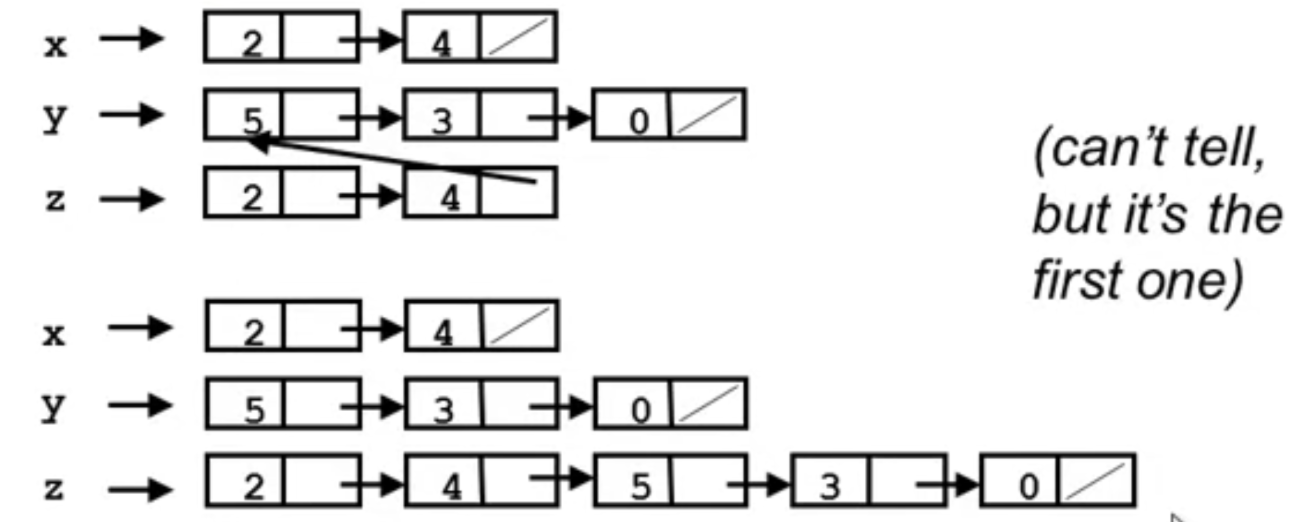
(1)可变性:ML中的变量是不可变的,某些语言中变量可变,比如python list是可变的,对于可变变量需要小心处理是否前后一致。
(2)赋值语句有两种结果:引用reference(别名alisa)vs复制(copy),alisa在内存层面引用的是原来的地址,copy是占用内存新建了一个变量,在ML中是alias
1
2
3
4
5
6
7
8
9
10
fun append(xs : int list, ys : int list) =
    if null xs
    then ys
    else hd(xs)::append(tl(xs), ys);

val x = [2, 4];
val y = [5, 3, 0];
val z = append(x, y);

# z的存储方式为第一种,返回的是ys的alias,而不是copy
9.Pieces
对于任何一种语言,需要关注一下5点
Syntax:语法
Semantics:语义,程序是什么意思(Evaluation rule)
Idioms:惯用语,有哪些典型的样式使用语言特征来表达计算
Libraries:有哪些可以帮助语言的使用更加标准,比如文件读取标准库
Tools:语言实现的工具,帮助开发,比如REPL,debuggerval